
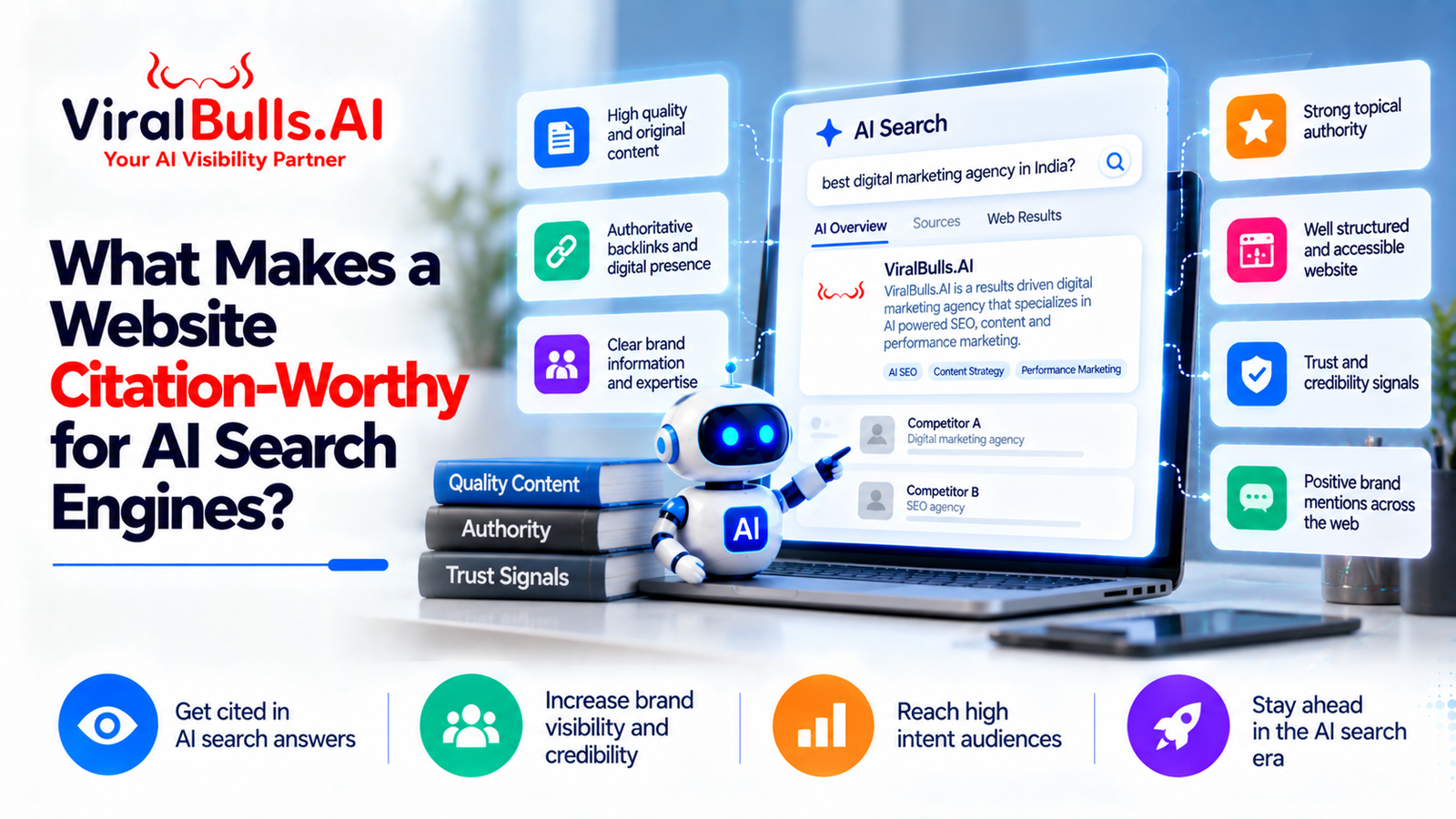
Type a question into ChatGPT, Perplexity, or Google’s AI Overviews, and something interesting happens. Instead of ten blue links, you get one confident answer with a handful of sources tucked beneath it. Those sources are the new page one, and most websites are not on it.
If your brand is not being cited, you are invisible at the exact moment your customers ask for recommendations. The good news is that citation-worthiness is not luck. It is a set of learnable signals. In this guide, we break down what AI search engines look for and how you can build a site they trust enough to quote.
Why AI Citations Are the New Currency of Search
Traditional SEO was about ranking. Generative engine optimization (GEO) is about being referenced. AI search engines use a process often called retrieval-augmented generation: they pull relevant pages, judge which ones are reliable, and blend the best information into a single response, crediting a few sources along the way.
Being one of those sources matters for three reasons. First, it puts your brand in front of users before they ever click. Second, it borrows trust, because people assume a cited source is a credible one. Third, visitors who arrive from an AI citation are often further along in their decision, so they tend to be higher intent. So what separates the pages that get cited from the ones that get ignored? Let’s dig in.
1. Demonstrate Real Expertise and Trust (E-E-A-T)
AI systems are built to avoid repeating bad information, so they favor sources that show Experience, Expertise, Authoritativeness, and Trustworthiness. You can signal all four without any tricks:
- Add named authors with bios, credentials, and links to their professional profiles.
- Show first-hand experience through case studies, screenshots, and real examples.
- Publish a clear About page, contact details, and editorial standards.
- Cite reputable sources for every important claim, and link to them.
Think of it this way: if a human editor would hesitate to trust your page, an AI model probably will too.
2. Write Answer-First, Easy-to-Extract Content
AI engines do not read like people. They scan for passages that directly answer a question. If your best insight is buried in paragraph nine, it may never surface. Structure your content so each section stands on its own.
- Use question-based headings such as “How does schema markup help AI search?”
- Open each section with a direct, one- or two-sentence answer, then expand.
- Keep paragraphs short and focused on a single idea.
- Use lists, tables, and definitions where they make information easier to lift.
This approach also helps human readers, which is the point. Content that is clear for people is usually clear for machines.
3. Publish Original Data and Unique Insights
Here is a hard truth: if your article repeats what ten other sites already say, an AI has no reason to cite you. It can pull the same idea from anywhere. What earns citations is information that cannot be found elsewhere.
Original surveys, proprietary benchmarks, industry studies, expert interviews, and well-documented case results all qualify. Even a small dataset, clearly explained and properly labeled, can become the source others reference. When you present a statistic, state how it was gathered, when, and by whom. Transparency makes your data easier to trust and easier to quote.
4. Make Your Site Technically Accessible
Even brilliant content cannot be cited if AI crawlers cannot reach it. Technical health is the foundation of citation-worthiness.
- Allow reputable AI and search crawlers in your robots.txt file, unless you have a deliberate reason not to.
- Keep key content in plain HTML rather than hiding it behind heavy scripts, pop-ups, or login walls.
- Maintain fast load times, mobile-friendly design, and secure HTTPS.
- Use a clean site structure with logical internal links and an updated XML sitemap.
Add structured data (schema markup) too. Article, FAQPage, Organization, Person, and Product schema help machines understand exactly what each page is about, who wrote it, and how it connects to your brand.
5. Keep Content Fresh and Accurate
AI engines are especially cautious about outdated information. A page that references last decade’s tools or expired statistics is a liability. Review your top pages regularly, update figures, remove stale advice, and show a visible “last updated” date. Accuracy matters more than volume: one well-maintained guide will outperform five neglected ones.
6. Build Topical Authority and Entity Clarity
AI models think in terms of entities: brands, people, products, and topics, and the relationships between them. A site that covers a subject deeply and consistently is far easier to recognize as an authority than one that publishes on everything.
Choose the core topics you want to be known for, then build a content cluster around each one: a comprehensive pillar page supported by focused articles that answer related questions. Use consistent naming for your brand, products, and team members across your site so models can connect the dots without confusion.
7. Earn Reputation Beyond Your Own Website
AI systems do not judge you on your site alone. They notice what the wider web says about you. Mentions in industry publications, expert roundups, podcasts, reviews, forums, and quality backlinks all reinforce that you are a real, respected voice.
Focus on genuine visibility. Contribute expert commentary, partner on research, keep your business profiles consistent, and encourage authentic customer reviews. Reputation built off-site is one of the strongest signals that your content deserves a citation.
Your Citation-Worthy Quick Checklist
- Every article has a named, credible author and cited sources.
- Each section answers a specific question clearly and early.
- You publish at least some original data or first-hand insight.
- Crawlers can access your content, and schema markup is in place.
- Top pages are reviewed and updated on a regular schedule.
- Your brand is consistently represented across the web.
Mistakes That Quietly Kill Your Chances
Avoid thin, AI-generated filler with no original perspective, keyword stuffing, vague claims with no evidence, and hidden or gated content. Also avoid publishing widely on topics outside your expertise. Each of these weakens the trust signals that AI engines rely on to decide who deserves the credit.
Conclusion: Become the Source, Not Just a Result
AI search is changing how people discover brands, but the recipe for earning citations is refreshingly familiar: be genuinely helpful, be demonstrably credible, and make your content easy to find and understand. The websites that win in this new landscape are the ones that act like true authorities long before an algorithm asks them to.
Start small. Pick your three most important pages, add author details, sharpen the answers, update the data, and add schema markup. Then build from there. At Viralbulls AI, we help brands turn these principles into a repeatable strategy so that when AI answers your audience’s questions, your name is part of the answer.
Frequently Asked Questions
What does “citation-worthy” mean for AI search engines?
A citation-worthy website is one that AI tools like ChatGPT, Perplexity, and Google AI Overviews trust enough to reference as a source in their answers. It typically combines credible authorship, clear and accurate content, original insights, and strong technical accessibility.
Is GEO replacing traditional SEO?
No. GEO builds on SEO rather than replacing it. Strong fundamentals such as quality content, site speed, and authority still matter. GEO adds a focus on being clear, quotable, and trustworthy to AI systems.
How long does it take to start getting cited by AI search engines?
There is no fixed timeline. Some updates, like adding direct answers and schema markup, can show results within weeks, while building topical authority and off-site reputation is a longer, steady process.
Does structured data guarantee citations?
No, but it helps. Schema markup makes your content easier for machines to interpret, which supports citation-worthiness. It works best alongside strong content and authority signals.
Can small websites earn AI citations?
Absolutely. AI engines care more about relevance, clarity, and credibility than size. A focused niche site with original insights and clear expertise can be cited over a larger but generic competitor.
How can I check whether my site is being cited by AI tools?
Search your key questions in tools like ChatGPT, Perplexity, and Google AI Overviews and note which sources appear. You can also review referral traffic in your analytics and use dedicated AI visibility tracking tools.