
Picture this: your marketing team celebrates a record month of leads. Down the hall, your sales team shrugs, because half of those leads were never going to buy. Sound familiar?
It is one of the oldest stories in business. Marketing says sales doesn’t follow up. Sales says marketing sends junk. Meanwhile, prospects slip away and revenue targets start to wobble.
The good news is that artificial intelligence is finally giving both teams a shared language, shared data and a shared scoreboard. In this guide, we’ll look at why alignment breaks down, how AI fixes it, and the practical steps you can take to get your teams pulling in the same direction.
Why Marketing and Sales Struggle to Align
Before we talk solutions, it helps to understand the problem. Sales and marketing serve the same customer, yet they often work from completely different playbooks. The most common friction points include:
- Different metrics. Marketing chases clicks, impressions and lead volume, while sales is measured on meetings booked and revenue closed.
- Disconnected tools. Campaign data lives in one platform, deal data in a CRM, and call notes in someone’s inbox. Nobody sees the full picture.
- No shared definition of a “good lead.” What marketing calls qualified, sales calls a waste of time.
- Slow, manual handoffs. Leads sit in queues, follow-ups are late, and interested buyers go cold.
These gaps are expensive. Wasted ad spend, missed follow-ups and mixed messaging all add up to a longer sales cycle and a weaker customer experience. This is exactly where AI steps in.
How AI Brings Marketing and Sales Together
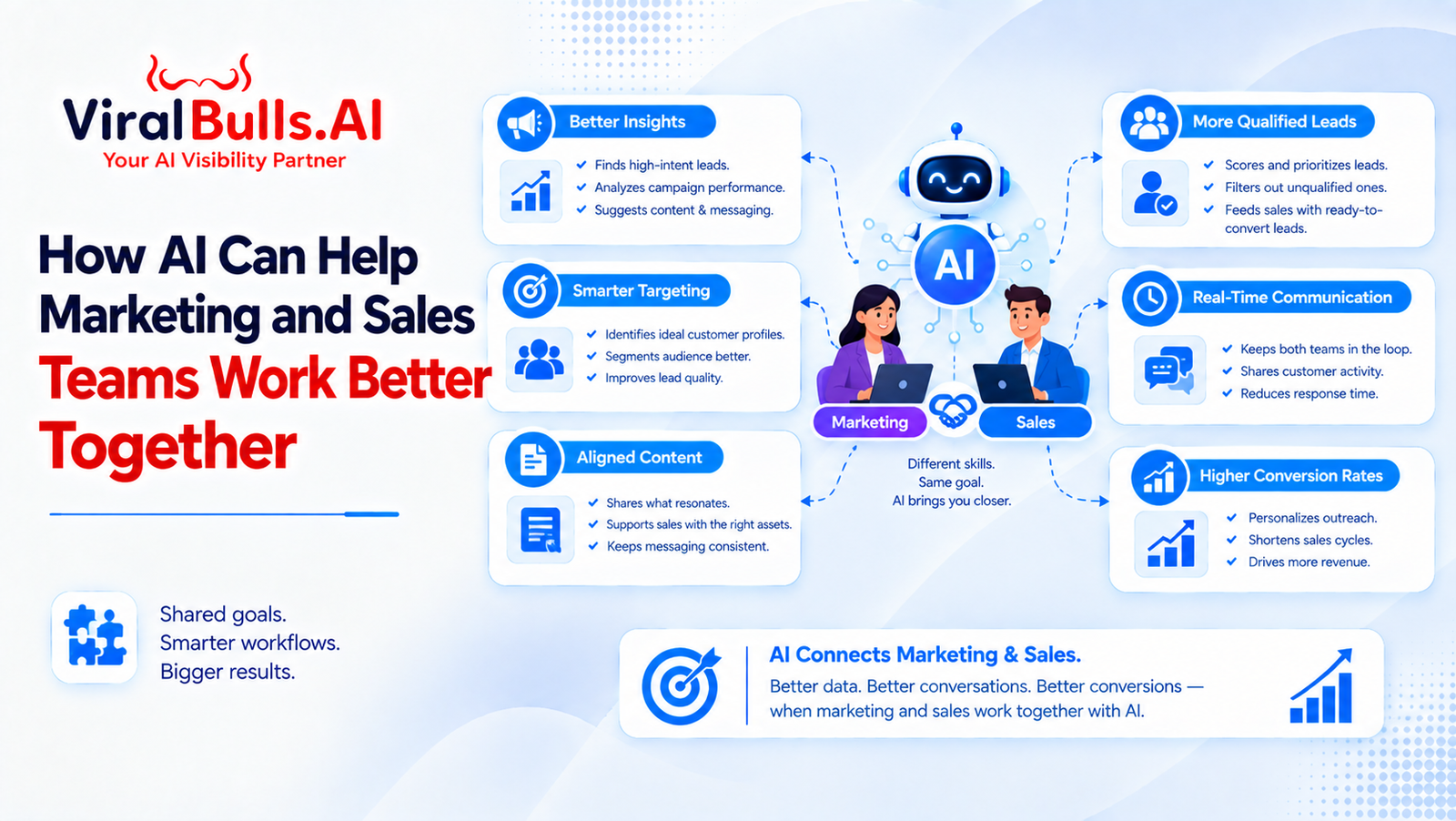
AI is not here to replace your people. Its real strength is removing the guesswork and manual effort that create friction between teams. Here are seven ways it does that.
1. Smarter Lead Scoring
Traditional lead scoring relies on rules someone set up years ago, such as “add 10 points for a whitepaper download.” AI-powered lead scoring studies your past wins and losses, then spots the behaviours and traits that truly predict a sale. Marketing learns which leads to nurture, sales gets a prioritised list, and both teams finally agree on what “qualified” means because the data backs it up.
2. One Source of Truth for Customer Data
AI tools can pull data from your website, email campaigns, social media, CRM and support tickets into a single customer view. Instead of arguing over whose numbers are right, both teams see the same journey: which ads a prospect clicked, which pages they read, and when they last spoke to a rep.
3. Personalisation at Scale
Buyers expect relevance. AI helps marketers tailor emails, landing pages and ad creatives to each segment, and it gives sales reps talking points based on what the prospect has already engaged with. The conversation feels continuous rather than starting from scratch at every handoff.
4. Content That Sales Actually Uses
How many case studies and brochures sit unused in a shared drive? AI can analyse which content appears in deals that close and recommend the right asset for the right stage. It can also help marketers draft sales emails, one-pagers and follow-up sequences in minutes, so reps spend less time searching and more time selling.
5. Conversation Intelligence as a Feedback Loop
Sales calls are a goldmine of insight that marketing rarely sees. AI can transcribe and summarise calls, highlighting common objections, competitor mentions and the exact words customers use to describe their problems. Marketing can feed those insights straight into messaging, blog topics and ad copy, while sales gets clearer coaching.
6. Predictive Forecasting and Attribution
Which channel really drives revenue? AI-driven attribution connects marketing touchpoints to closed deals, so budgets follow what works. On the sales side, predictive forecasting flags deals at risk and shows where the pipeline is thin, giving marketing an early signal to launch a targeted campaign before the gap becomes a shortfall.
7. Automated Handoffs and Follow-Ups
Speed wins deals. AI can route hot leads to the right rep instantly, trigger personalised follow-ups, schedule meetings and remind teams when a prospect goes quiet. Chatbots can even qualify visitors around the clock, so your team wakes up to warm, ready-to-talk conversations.
A Simple Roadmap to Get Started
You don’t need a massive overhaul to see results. Start small and build momentum with this step-by-step approach:
- Agree on shared goals. Choose a few joint metrics, such as pipeline generated, conversion rate by stage and revenue influenced, and make both teams accountable for them.
- Audit your data. AI is only as good as the information it learns from. Clean up your CRM, remove duplicates and make sure lead sources are tracked consistently.
- Define your ideal customer together. Use AI insights from won and lost deals to build a shared ideal customer profile and a common definition of a qualified lead.
- Pilot one use case. Begin with AI lead scoring or automated follow-ups. Measure the results over 60 to 90 days before expanding.
- Hold regular feedback sessions. Set up a short weekly or fortnightly meeting where both teams review AI-generated insights and adjust strategy together.
- Train your people. Make sure everyone understands how the tools work and why they help. Adoption matters more than the technology itself.
Common Pitfalls to Avoid
- Treating AI as a magic fix. Technology can’t repair a broken process or a culture of blame. Align on strategy first.
- Ignoring data privacy. Handle customer data responsibly and follow regulations that apply to your market.
- Removing the human touch. Use AI to support relationships, not replace them. Buyers still want to talk to real, helpful people.
- Skipping measurement. Track outcomes from day one so you can prove what’s working and refine what isn’t.
Final Thoughts: Turn Two Teams into One Revenue Engine
When marketing and sales work in silos, everyone loses, including the customer. AI offers a practical way to close the gap by connecting data, sharpening lead quality, speeding up follow-ups and creating a constant feedback loop between the people who attract customers and the people who win them.
The businesses that thrive over the next few years will be the ones that treat marketing and sales as a single revenue team, powered by smart tools and shared goals. The best time to start is now, and you can begin with just one small step.
Ready to bring AI into your marketing and sales strategy? Connect with the team at Viralbulls AI and discover how the right tools and expertise can help you generate better leads, close more deals and grow with confidence.
Frequently Asked Questions (FAQ)
1. How does AI improve collaboration between marketing and sales teams?
AI creates a shared view of customer data, scores leads based on real buying signals, automates handoffs and turns sales conversations into insights for marketing. This removes guesswork and gives both teams the same facts to work from.
2. Do small businesses need AI for sales and marketing alignment?
Not necessarily at a large scale, but many affordable AI tools now suit small teams. Even simple features like automated follow-ups, email personalisation and basic lead scoring can save time and improve results.
3. Will AI replace sales or marketing professionals?
No. AI handles repetitive tasks such as data entry, scheduling and first-draft content, so people can focus on strategy, creativity and building relationships, which machines cannot replicate.
4. What is the first AI tool a team should adopt?
For most teams, AI-powered lead scoring or automated lead follow-up delivers the fastest and most visible win. Choose the area where your teams currently lose the most leads or time.
5. How long does it take to see results?
Simple automations can show improvements within weeks. Deeper benefits such as better forecasting and attribution usually appear after two to three months, once the AI has enough quality data to learn from.
6. How do we measure whether AI is improving alignment?
Track shared metrics such as lead-to-opportunity conversion rate, speed to first response, sales cycle length, pipeline generated and revenue influenced by marketing. Improvement across these indicates stronger teamwork.