For years, businesses trying to increase online visibility had one obvious priority: SEO.
You researched keywords, optimized website pages, published useful content, earned backlinks, improved technical performance, and tried to climb higher in Google search results.
But search behavior is changing.
People are increasingly asking complete questions through AI-powered search experiences and conversational assistants. Instead of reviewing ten blue links, users may receive a summarized answer containing recommendations, explanations, comparisons, and selected sources.
That change has introduced another term into digital marketing: GEO, or Generative Engine Optimization.
GEO focuses on improving the likelihood that a brand, website, product, or expertise is understood, surfaced, referenced, or cited within AI-generated answers. The concept emerged alongside generative search systems that synthesize information from multiple sources rather than simply presenting a traditional ranked list.
So businesses are now asking an important question:
Do we still need SEO, or should we invest in GEO instead?
The answer is usually not one or the other.
SEO and GEO solve different parts of the same visibility problem, and businesses that understand how they work together can build a stronger presence across both conventional search engines and AI-powered discovery platforms.
What Is SEO?
SEO stands for Search Engine Optimization.
It is the process of improving a website so that search engines can crawl, understand, index, and rank its pages for relevant queries.
The traditional objective is to increase organic visibility and attract qualified visitors from search results.
For example, if someone searches:
“AI marketing agency in Noida”
an agency offering those services may optimize its website to appear prominently for that query.
SEO generally includes several interconnected areas.
Keyword Research
Businesses identify the terms potential customers search for.
SEO specialists evaluate factors such as:
- Search volume
- Search intent
- Competition
- Keyword relevance
- Commercial potential
- Related topics and questions
These insights help determine which pages and content should be created.
On-Page SEO
On-page SEO improves the content and structure of individual pages.
It typically covers:
- Page titles
- Meta descriptions
- Headings
- Content structure
- Keyword usage
- Internal links
- Image optimization
- URLs
- Search intent alignment
The goal is to make every page useful to the reader while clearly communicating its purpose to search engines.
Technical SEO
Even excellent content can struggle when a website has technical problems.
Technical SEO focuses on areas including:
- Crawlability
- Indexability
- Website speed
- Mobile usability
- Site architecture
- Canonicalization
- Structured data
- XML sitemaps
- HTTPS
- Duplicate content management
These elements create the technical foundation upon which organic search performance is built.
Off-Page SEO
Search engines also evaluate signals outside the website.
Off-page SEO can include:
- Backlink acquisition
- Digital PR
- Brand mentions
- Guest publishing
- Industry citations
- Local citations
- Authority building
Together, these activities help establish trust and relevance.
What Is GEO?
GEO stands for Generative Engine Optimization.
Rather than focusing only on where a webpage ranks, GEO considers whether generative AI systems can accurately understand, retrieve, use, cite, or recommend information about a business.
The original academic work describing GEO framed it as a way for content creators to improve visibility within generative engines, which synthesize responses from multiple information sources.
This creates a different type of visibility challenge.
Imagine a user asks an AI assistant:
“Which type of marketing agency should a B2B SaaS company choose if it wants to improve visibility in both Google and AI search?”
The user may receive a complete answer without conducting multiple traditional searches.
The question for a business becomes:
Will our brand or content become part of that answer?
That is where GEO becomes relevant.
GEO vs SEO: What Is the Main Difference?
The simplest distinction is:
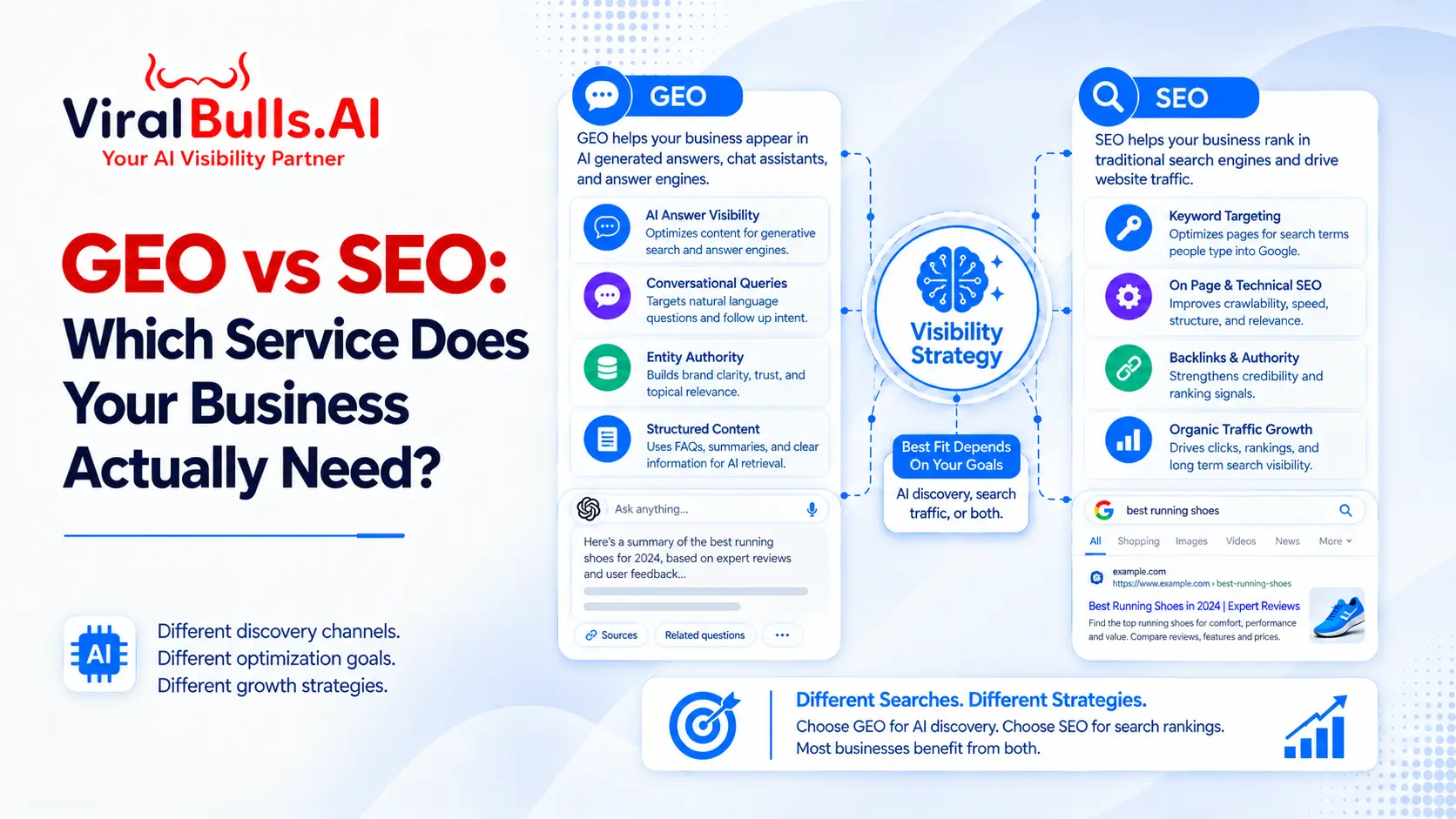
SEO aims to improve where your website appears in search results.
GEO aims to improve how your brand and information appear within generative AI answers.
However, the two are closely connected.
Google’s current guidance states that established SEO best practices remain relevant to its generative AI search features because those experiences are connected to Google’s core search and quality systems. Google also treats terms such as GEO and AEO largely as approaches focused on visibility within evolving search experiences rather than replacements for SEO fundamentals.
That means businesses should avoid thinking of GEO as a completely separate marketing universe.
In practice, strong GEO frequently begins with strong SEO.
SEO vs GEO: A Quick Comparison
| Area | SEO | GEO |
|---|---|---|
| Primary Goal | Improve search engine visibility | Improve visibility within AI-generated answers |
| Main Environment | Traditional search results | Generative and conversational search |
| Typical User Behavior | Searches keywords and visits results | Asks detailed questions and receives synthesized answers |
| Content Focus | Keywords, intent and rankings | Context, entities, authority and answer usefulness |
| Main Outcome | Rankings, clicks and organic traffic | Mentions, citations, references and AI visibility |
| Technical Foundation | Crawlability and indexability | Machine accessibility plus strong SEO foundations |
| Authority Signals | Backlinks and domain authority | Brand authority, credible mentions and reliable information sources |
| Measurement | Rankings, clicks, traffic, conversions | AI mentions, citations, source visibility and assisted discovery |
| Strategy | Search engine focused | Generative discovery focused |
How SEO Works in Practice
Suppose a cybersecurity company wants to promote its penetration testing service.
An SEO strategy might begin by researching searches such as:
- Penetration testing services
- Cybersecurity testing company
- Web application penetration testing
- Penetration testing cost
- Vulnerability assessment vs penetration testing
The company might then create:
- A service page
- Supporting blogs
- Comparison articles
- FAQs
- Case studies
Those pages would be optimized technically and internally linked.
Backlinks and external authority would then help improve the site’s ability to rank.
Success could be measured through:
Rankings → Impressions → Clicks → Leads → Customers
That remains an extremely important digital acquisition model.
How GEO Works in Practice
Now imagine a prospect asks an AI platform:
“What should I look for when selecting a penetration testing provider for a SaaS business handling customer payment data?”
The AI system may combine information from various sources into one response.
For the cybersecurity company to become visible in that environment, its online presence needs to make its expertise exceptionally clear.
Its website might clearly explain:
- What penetration testing it provides
- Which industries it serves
- Which methodologies it follows
- Which security standards it understands
- Who its experts are
- What outcomes clients have achieved
- How its approach differs from competitors
External sources may also reinforce the company’s credibility through reviews, interviews, industry publications, independent mentions, research, directories, or expert commentary.
GEO therefore extends optimization beyond an individual webpage.
It considers the overall digital understanding of the brand.
Key Difference 1: Keywords vs Conversations
SEO traditionally starts with keywords.
GEO increasingly starts with questions.
For example:
SEO Query
“Best CRM software”
Generative Search Query
“What CRM would you recommend for a 25-person B2B company that needs sales automation, simple reporting, and minimal technical setup?”
The second query contains significantly more context.
Businesses therefore need content that does more than mention high-volume keywords.
They need to answer the real questions surrounding customer decisions.
Key Difference 2: Ranking vs Being Included in the Answer
With SEO, success often means appearing near the top of the search results.
With GEO, visibility can take several forms.
A business may be:
- Mentioned
- Recommended
- Cited
- Used as a source
- Included in a comparison
- Associated with a particular solution or category
That creates a major strategic difference.
A website does not necessarily need someone to search its exact brand name before the brand enters the conversation.
The brand could potentially appear while the user is still researching the problem.
Key Difference 3: Website Authority vs Entity Authority
Traditional SEO has placed substantial emphasis on website authority.
GEO makes brand and entity clarity increasingly important.
AI systems need consistent information about:
- Who your company is
- What you do
- Who you serve
- Where you operate
- What expertise you possess
- Which products or services you provide
If your website describes your company one way, industry directories describe it another way, and your external coverage tells a different story, the brand becomes harder to interpret confidently.
Consistency across your digital footprint therefore matters.
Key Difference 4: Traffic vs Visibility Before the Click
SEO campaigns frequently evaluate performance through organic website traffic.
GEO introduces another layer.
Users might discover your brand through an AI answer before they ever visit your website.
The AI experience could influence:
- Brand awareness
- Product consideration
- Vendor shortlisting
- Purchase research
- Brand perception
This means marketers may eventually need to evaluate visibility not only by clicks but also by how frequently and accurately their brands appear across relevant AI-driven research journeys.
Does GEO Replace SEO?
No.
Businesses should be cautious of anyone suggesting that conventional SEO has suddenly become irrelevant.
Google explicitly states that foundational SEO practices remain important for its generative AI search experiences.
Without basic SEO, businesses may still struggle with fundamental problems such as:
- Pages not being indexed
- Poor website architecture
- Weak content
- Unclear topical relevance
- Limited authority
- Poor user experience
GEO cannot magically compensate for a website that search systems cannot properly access or understand.
Think of SEO as the foundation and GEO as an additional visibility layer.
When Does Your Business Primarily Need SEO?
SEO should be a major priority if:
- Your target customers actively search Google for your services.
- Your website receives little organic traffic.
- Important service pages do not rank.
- Competitors consistently outrank you.
- Your site has technical SEO problems.
- You have not built topical authority.
- Your local business depends on search discovery.
- Organic leads are an important acquisition channel.
For many companies, particularly local businesses, ecommerce brands, SaaS companies and professional service providers, SEO remains indispensable.
When Should You Invest More Seriously in GEO?
GEO deserves increased attention when:
- Customers research your category using AI tools.
- Your buying journey involves extensive research and comparison.
- You operate in a competitive B2B sector.
- Expert authority strongly influences purchasing decisions.
- Your brand needs to appear in recommendation-oriented conversations.
- You already have a strong SEO foundation.
- You publish significant educational or thought-leadership content.
- AI-generated discovery is becoming relevant to your market.
GEO is particularly important for businesses whose customers ask complex questions before purchasing.
What If Your Business Needs Both?
For most growth-focused businesses, this is increasingly the correct answer.
Rather than building completely separate SEO and GEO programs, create an integrated visibility strategy.
A strong approach could include:
1. Fix Your SEO Foundation
Start with:
- Technical SEO
- Keyword research
- Search intent
- Website architecture
- Internal linking
- On-page optimization
Your website needs to be discoverable before advanced optimization can deliver consistent value.
2. Create Expert-Led Content
Do not publish generic articles simply to increase page count.
Create content containing:
- Original insights
- Expert opinions
- Practical examples
- Industry experience
- Statistics
- Research
- Case studies
- Detailed answers
Google also warns that generating large quantities of AI-created pages without adding meaningful value can conflict with its spam policies.
3. Answer Specific Customer Questions
Build content around the questions customers ask before making decisions.
For example:
Instead of publishing only:
“AI Marketing Services”
also create content answering:
“How can a B2B company measure whether AI marketing is actually improving lead quality?”
More specific content gives both users and search systems richer context.
4. Strengthen Brand Authority Beyond Your Website
Do not rely entirely on your own domain.
Build credible third-party visibility through:
- Digital PR
- Industry publications
- Expert contributions
- Interviews
- Relevant directories
- Case studies
- Reviews
- Partnerships
This strengthens overall brand authority.
5. Make Your Business Easy to Understand
Your service pages should clearly explain:
What you do. Who you help. How you do it. What makes you different. Why customers should trust you.
Clarity benefits users, search engines, and AI-powered discovery systems.
SEO or GEO: Which Should You Choose?
The decision depends on your current position.
If your website barely ranks on Google, investing exclusively in GEO would be premature.
Build your SEO foundation first.
If your organic presence is already strong but your brand rarely appears when users research your category through AI platforms, expand into GEO.
And if your customers already move between Google, AI search, social media, review platforms and industry websites during their buying journey, your strategy should address both.
The goal is no longer simply:
“Rank number one.”
It is:
“Be visible wherever customers look for answers.”
The Future Is SEO + GEO
SEO and GEO should not be treated as competing services.
They are different components of modern search visibility.
SEO helps your website become discoverable through search engines.
GEO helps your brand become understandable and potentially visible within AI-generated discovery experiences.
One focuses heavily on rankings and traffic.
The other expands the conversation toward mentions, citations, recommendations and AI-assisted research.
But both depend on many of the same fundamentals:
- Strong content
- Clear expertise
- Technical accessibility
- Authority
- Trust
- Relevance
- Consistent brand information
For businesses, the smartest approach is therefore not choosing between SEO and GEO blindly.
It is identifying where your current visibility gaps exist and investing accordingly.
At Viralbulls AI, the approach is built around this broader evolution of search. By combining established SEO strategies with AI-focused visibility optimization, businesses can prepare for how customers search today while building a stronger presence for how they will discover brands tomorrow.
Because modern search visibility is no longer only about earning a place on Google’s first page.
It is about making sure your brand can be found, understood, trusted and recommended across the entire search ecosystem.