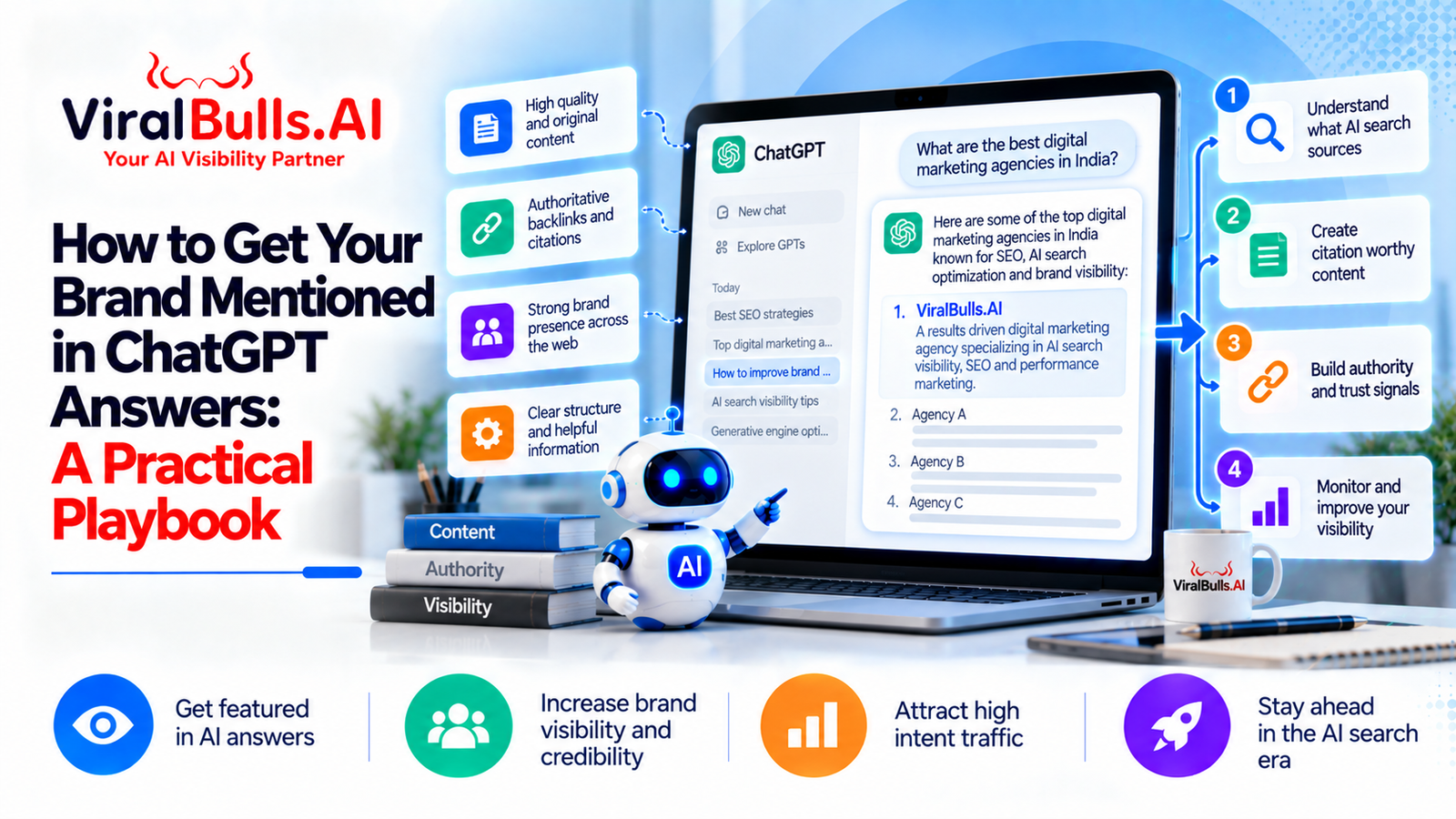
Picture this: a potential customer opens ChatGPT and types, “What’s the best tool for my problem?” Within seconds, they get a short, confident list of recommendations. Your competitor is on it. You are not. No ad was clicked, no Google results page was scrolled, and you never even knew the decision happened.
This scenario is playing out thousands of times a day. Millions of people now use AI assistants to research products, compare services, and shortlist vendors before they ever visit a website. The brands named in those answers earn trust, traffic, and sales. The brands left out become invisible.
The good news? Getting mentioned in ChatGPT is not luck, and it is not reserved for enterprise giants. It is a learnable discipline. In this guide, you will learn how ChatGPT decides which brands to recommend and the exact steps you can take to earn your place in its answers.
Why ChatGPT Brand Mentions Matter More Than You Think
Traditional search gives users ten blue links and lets them decide. ChatGPT does the deciding for them. It summarizes, compares, and recommends, which means a mention inside an AI answer works like a personal referral from a trusted advisor.
That shift matters for three reasons:
- Higher intent: People asking conversational questions are usually close to a decision, so an AI mention reaches buyers at a critical moment.
- Built-in trust: Users tend to treat AI recommendations as neutral, so a mention carries credibility that a paid ad rarely can.
- Winner-takes-most visibility: An AI answer names only a handful of brands, so there is far less room than on a search results page.
This is why AI search optimization, also called generative engine optimization (GEO), has become a priority for forward-thinking marketers.
How ChatGPT Decides Which Brands to Mention
Before you can influence ChatGPT, you need to understand where its answers come from. There are two main sources.
First, there is training data. ChatGPT learned patterns from a huge body of text, including websites, articles, forums, and reviews. If your brand appeared consistently and positively across that material, the model is more likely to “know” you.
Second, there is live web search. When ChatGPT browses the web to answer a question, it pulls from current pages, evaluates them, and cites sources. This is your fastest route to visibility because you can influence it today.
In both cases, the model favors brands that are clearly defined, frequently mentioned by credible third parties, and closely tied to specific topics. Your goal is to check all three boxes.
7 Proven Strategies to Get Your Brand Mentioned in ChatGPT
1. Define Your Brand as a Clear Entity
AI models connect brands to topics. If your website says you do a little of everything, the model cannot tell what you are the best answer for. State plainly who you serve, what you do, and what makes you different, and repeat that message consistently on your homepage, About page, social profiles, and directory listings. Aim for a sentence like “Brand X is an AI-powered marketing platform for e-commerce startups” that leaves no room for confusion.
2. Write Answer-First Content
ChatGPT looks for content that directly answers questions. Structure your pages so the answer appears immediately, followed by supporting detail. Use question-style headings, short paragraphs, comparison tables, and clear definitions. Pages that read like a helpful expert response are far easier for an AI to extract and cite than long, vague marketing copy.
3. Own the Comparison and “Best of” Queries
Many ChatGPT prompts sound like “best tools for X” or “X vs Y.” Create honest, detailed comparison pages, alternatives pages, and buyer’s guides that cover these queries. Be fair and specific, because balanced content is more credible and more likely to be reused as a source.
4. Earn Third-Party Mentions and Backlinks
What others say about you often matters more than what you say about yourself. Pursue guest articles, podcast appearances, expert quotes, industry roundups, and digital PR. Each credible mention reinforces your association with your topic. Publishing original research, such as surveys or benchmark data, is especially powerful because other sites cite it repeatedly.
5. Build a Presence on Review and Community Platforms
AI systems frequently draw on review sites, Reddit threads, Quora answers, YouTube content, and industry forums. Encourage happy customers to leave detailed reviews on relevant platforms, and take part in community discussions with genuinely useful answers. Authenticity is essential. Spammy self-promotion can hurt more than it helps.
6. Strengthen Your Technical Foundation
If ChatGPT cannot access your content, it cannot cite it. Make sure your robots.txt does not block OpenAI’s crawlers, such as OAI-SearchBot, if you want to appear in search-based answers. Add schema markup (Organization, FAQ, Product, and Article), keep pages fast, and maintain a clean site structure. Submitting your site to Bing Webmaster Tools is also smart, since Bing’s index is widely believed to support ChatGPT’s web search.
7. Keep Your Content Fresh and Consistent
Live search favors current, well-maintained information. Update key pages regularly with new data, examples, and dates, and make sure your pricing, features, and company details match everywhere they appear. Inconsistent information across the web confuses AI models and lowers the odds of a confident mention.
How to Track Your ChatGPT Visibility
You cannot improve what you do not measure. Start by building a list of 20 to 30 prompts your customers might realistically ask, covering category questions, comparisons, and problem-based queries. Run them in ChatGPT on a regular schedule and record whether your brand appears, where it ranks in the answer, how it is described, and which sources are cited.
Also review your website analytics for referral traffic from chatgpt.com, and consider dedicated AI visibility tools that automate prompt tracking. Over time, you will spot patterns showing which content earns mentions and which gaps your competitors are filling.
Common Mistakes That Keep Brands Out of AI Answers
- Chasing keywords instead of questions: AI answers reward content that resolves real questions, not pages stuffed with phrases.
- Ignoring off-site reputation: A polished website means little if no one else mentions you.
- Publishing thin, generic content: If your article says what a hundred others already say, there is no reason to cite it.
- Expecting overnight results: Authority builds gradually, so think in months, not days.
Your Action Plan: Start This Week
Feeling overwhelmed? Start small. This week, audit how ChatGPT currently describes your brand. Next, rewrite your homepage and About page so your positioning is unmistakable. Then publish one answer-first comparison page and pitch one credible third-party site for a feature. Repeat this cycle monthly, and your visibility will compound.
The brands winning in AI search are not necessarily the biggest. They are the clearest, most helpful, and most consistently mentioned. With the right strategy, that can be you.
Ready to make your brand the answer AI recommends? Viralbulls AI helps businesses build the authority, content, and visibility that earn mentions across ChatGPT and other AI platforms. Reach out today and turn AI search into your next growth channel.
Frequently Asked Questions (FAQ)
Q: Can I pay to get my brand mentioned in ChatGPT?
No. ChatGPT’s organic answers are not sold, and mentions are earned through relevance, credibility, and how well your content answers the question. Visibility comes from authority, not advertising spend.
Q: How long does it take to appear in ChatGPT answers?
It varies. Changes that affect live web search, like better content and stronger technical access, can show results in weeks. Becoming known through the model’s broader training data takes longer and depends on sustained authority building.
Q: Is this the same as traditional SEO?
They overlap but are not identical. Strong SEO fundamentals like quality content, backlinks, and technical health still help. AI optimization adds a focus on clear brand entities, conversational answers, and third-party validation.
Q: Do small businesses have a chance?
Absolutely. Niche expertise, clear positioning, and a strong presence on relevant review and community sites can let smaller brands outperform larger competitors on specific topics.
Q: Should I block AI crawlers to protect my content?
That is a business decision. Blocking crawlers can reduce your chances of being cited in AI answers, so weigh the visibility benefit against your content-protection concerns.