
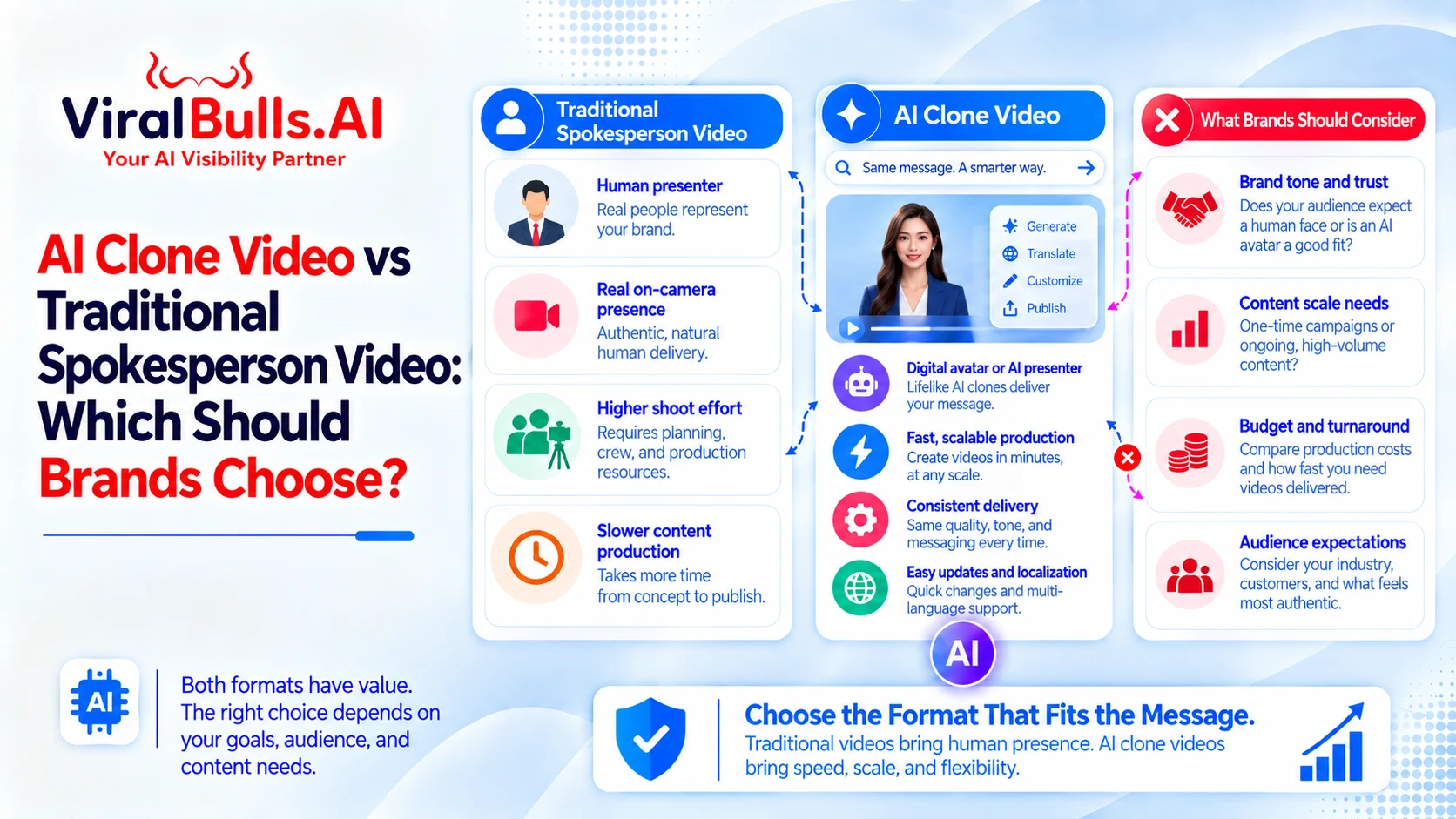
A strong spokesperson can make a complex offer feel simple, give a faceless company a personality, and hold attention long enough for the message to land.
Traditionally, producing that video meant casting, scheduling, location planning, lighting, recording, retakes, editing, and new shoots whenever the script changed.
An AI clone video can now deliver an approved script through a synthetic version of a real person. Brands can also use generic AI presenters for repeatable video production.
That speed is valuable, but not every message should be synthetic. The right choice depends on whether the campaign needs scale, performance testing, human emotion, real-world proof, or a recognizable person.
What Is a Traditional Spokesperson Video?
A traditional spokesperson video features a real person recorded on camera. The spokesperson may be a founder, employee, actor, expert, influencer, or customer.
The performance is captured in a real production environment and shaped through direction, editing, graphics, and sound. The person’s natural delivery, gestures, timing, and emotion become part of the creative.
This format is established because viewers understand the visual contract: a real person stood in front of a camera and delivered the message.
What Is an AI Clone Video?
An AI clone video uses a consented digital model of a specific person’s appearance and voice to generate new video output from approved scripts.
AI spokesperson videos may also use stock or custom virtual presenters that do not represent a real company leader. Both formats can be useful, but they serve different brand purposes.
A founder clone carries existing identity and authority. A generic AI presenter functions more like a scalable digital actor.
Where AI Clone Videos Perform Best
- Frequent product updates and feature announcements
- Localized videos across languages or regions
- Short educational series with a repeatable structure
- Personalized sales and onboarding messages
- Multiple paid-ad hooks built from one approved offer
- Internal training and operational communication
These use cases are script-led and repeatable. They benefit from speed, consistency, and the ability to revise without recalling the spokesperson.
Where Traditional Spokesperson Videos Remain Stronger
Traditional production is stronger when performance and physical context carry the message.
A real presenter can interact naturally with a product, respond to another person, move through a location, demonstrate a process, or communicate emotion that does not feel pre-programmed.
Founder stories, customer interviews, hospitality experiences, major announcements, and high-value brand films usually benefit from real presence. Viewers may forgive imperfect delivery because those imperfections support credibility.
Trust Is Not Automatically Owned by Either Format
A real actor reading a misleading claim is not trustworthy simply because the video was filmed traditionally. An AI clone delivering accurate, approved information is not automatically deceptive simply because it was generated.
Trust depends on truthful claims, appropriate disclosure, recognizable context, and whether the presentation creates a false impression.
Brands should never use AI to fabricate a customer experience, impersonate someone without consent, or create endorsements from people who did not use the product. FTC rules prohibit fake or false testimonials, including testimonials that misrepresent a non-existent person as having real experience.
Cost and Speed: The Most Visible Difference
Traditional video cost grows with production complexity and the number of variations. Each change can require new availability, setup, performance, and editing.
AI clone videos carry an initial setup and quality-control cost, but repeated production can become faster. A revised offer, new language, or shorter version may be generated without another physical shoot.
The financial comparison should include the full workflow, not just the generation fee. Strategy, scripting, approvals, editing, brand design, legal review, and media testing still matter.
Control vs Performance
AI provides tight control over words, duration, pronunciation, and consistency. That is useful in regulated or operational communication where small deviations create problems.
Traditional spokespersons contribute interpretation. A skilled presenter may improve a line through pacing, facial expression, or emphasis. That creative contribution can make the final video stronger than the written script.
Brands should decide whether the message needs controlled repetition or human performance.
The Hybrid Production Model
The best choice is often a planned combination.
A brand can record a real spokesperson for campaign films, customer-facing trust assets, and important announcements. The same approved person can then create a consented clone for routine updates, language versions, and high-volume content.
Alternatively, AI spokesperson videos can test scripts and hooks before the company invests in a full production. Performance data can then guide casting and shooting decisions.
How ViralBulls Chooses the Right Video Format
ViralBulls starts with the communication objective rather than the production technology.
We assess the claim, audience, platform, volume, localization requirement, trust level, and expected shelf life of the asset. Based on that, we recommend an AI clone, generic AI presenter, traditional spokesperson, or hybrid approach.
Our process includes scripting, brand alignment, production, editing, variation planning, and campaign use. The goal is not to make synthetic content look clever. It is to create video that communicates effectively and can be used responsibly.
Final Verdict: Choose Based on the Message
Choose an AI clone video when the brand needs repeatable, controlled, multilingual, and scalable communication.
Choose a traditional spokesperson when emotion, physical interaction, spontaneity, and real presence are central to persuasion.
Use a hybrid model when you want the credibility of real production and the efficiency of AI-powered distribution.
AI Clone Video vs Traditional Spokesperson Video
| Factor | AI Clone Video | Traditional Spokesperson |
|---|---|---|
| Speed | Fast after setup | Depends on scheduling and production |
| Variations | Easy to create multiple scripts and languages | New versions may require reshoots |
| Performance | Consistent and controlled | Natural, expressive, and adaptive |
| Physical demonstration | Limited by generation method | Strong for real product interaction |
| Trust | Depends on consent, context, and transparency | Benefits from visible real presence |
| Best use | Repeatable updates and scalable content | Campaign films, stories, and emotional communication |
Questions to Ask Before Choosing a Presenter
Begin with the role the person plays in the message. Are they delivering approved information, demonstrating a product, representing leadership, acting in a scenario, or claiming personal experience? The closer the role is to an endorsement or testimonial, the more important real experience and identity become.
Consider how many versions the campaign needs. A single brand film may justify a traditional shoot, while dozens of language, offer, and audience variations may favor an AI-supported workflow. Production volume changes the economics significantly.
Review how long the asset must remain useful. Time-sensitive performance ads benefit from rapid iteration. A flagship brand video may require distinctive cinematography, a real environment, and a performance that can represent the company for years.
Finally, plan ownership and permissions. Contracts should define usage duration, channels, territories, editing rights, AI training consent, and what happens when the relationship ends. This protects both the brand and the person represented.
Platform context should influence the decision as well. A fast-moving paid social campaign may reward native, direct delivery, while a website homepage or investor presentation may demand more deliberate production. One presenter format does not need to serve every channel.
Brands should also test audience reaction rather than relying on internal preference. Compare retention, qualified clicks, comments, conversion quality, and brand feedback. The winning format is the one that communicates the message accurately and moves the right audience, not the one the production team finds most impressive.
Frequently Asked Questions
An AI clone represents a specific consenting person. An AI spokesperson may be a generic virtual presenter created for broad commercial use.
They can be used legally when identity, voice, and source materials are used with permission and the content complies with advertising, privacy, intellectual-property, and platform rules.
They often feel more natural, particularly when real interaction or emotion matters. Trust still depends on truthful claims and appropriate context.
Yes. Localization is a major advantage, but translations and pronunciation should be reviewed by people familiar with the target market.
AI can help create and test variations efficiently. Traditional spokespersons may be stronger for high-trust concepts. Many brands benefit from testing both.
Use explicit consent, restricted access, script approvals, secure asset storage, usage boundaries, and a process for withdrawing or updating permissions.